Home

/

Blog

/

Mapping behaviour, not screens

September 5, 2025

Mapping behaviour, not screens: Applying UX to course design
I’m working away on my self-directed course about giving feedback, and still figuring things out as I go. So far I’ve got:

  • A working title: Feedback that fuels growth
  • A set of learning objectives:
    • Identify the key traits of constructive vs. unhelpful feedback
    • Use a simple framework (like SBI or COIN) to deliver clear, respectful feedback
    • Reflect on feedback without defensiveness
    • Ask for feedback that supports specific goals or outcomes

This all definitely gave me some direction, but when it came to how to actually teach those ideas? That was a different story.

At first, I figured I’d start with what people needed to know. That seemed logical. But it turns out knowledge isn’t the goal. Action is.

I needed a way to connect the end goal to what I was going to show, explain, or build activities around.

Enter: Action mapping

What is Action Mapping?

If you Google it, action mapping looks a bit like a mind map. But it’s much more structured and targeted.

Originally developed by Cathy Moore, action mapping is a visual approach to learning design that focuses on behaviour change. You start with a business or performance goal at its heart, then work backwards:

  • What do people need to do?
  • What’s getting in their way?
  • What practice or support could help?

No content for content’s sake. No five-slide explainers just because. Everything in service of the desired behaviour.

It felt a bit like a journey map for learning. Less about information, more about the steps and support needed along the way. I had to map not just what people should know, but everything they’d need to do to put feedback into practice. Where they might get stuck. What would help.

As a UX designer, this wasn’t unfamiliar. We often use journey maps or experience maps to do the same thing: start with the user’s goal, chart their steps, and figure out where interventions actually matter.

In both cases, mapping is about connecting outcomes to real behaviour changes, and clarifying where design effort will have the most impact. Whether you’re building a digital product or a course, that’s what it comes down to.

Why I used it

I didn’t want to build a passive “here’s what feedback is” module. The goal was to help people actually give better feedback, in real situations, not just in theory.

So I treated this like any other design challenge:

  • What actions do I want people to take?
  • Where are they getting stuck?
  • What do they need to practise?

Action mapping helped me step back from the urge to “cover everything,” and instead focus on doing less, better.

What it helped clarify

  • Which objectives needed active practice, and which were fine with a short example or explainer
  • Where I was making assumptions about what people already knew
  • Which content was just “nice to have” and didn’t need to be there at all

It also shifted how I was thinking about the module. I stopped planning slides, and started planning activities. What would learners do with the ideas, not just hear or read?
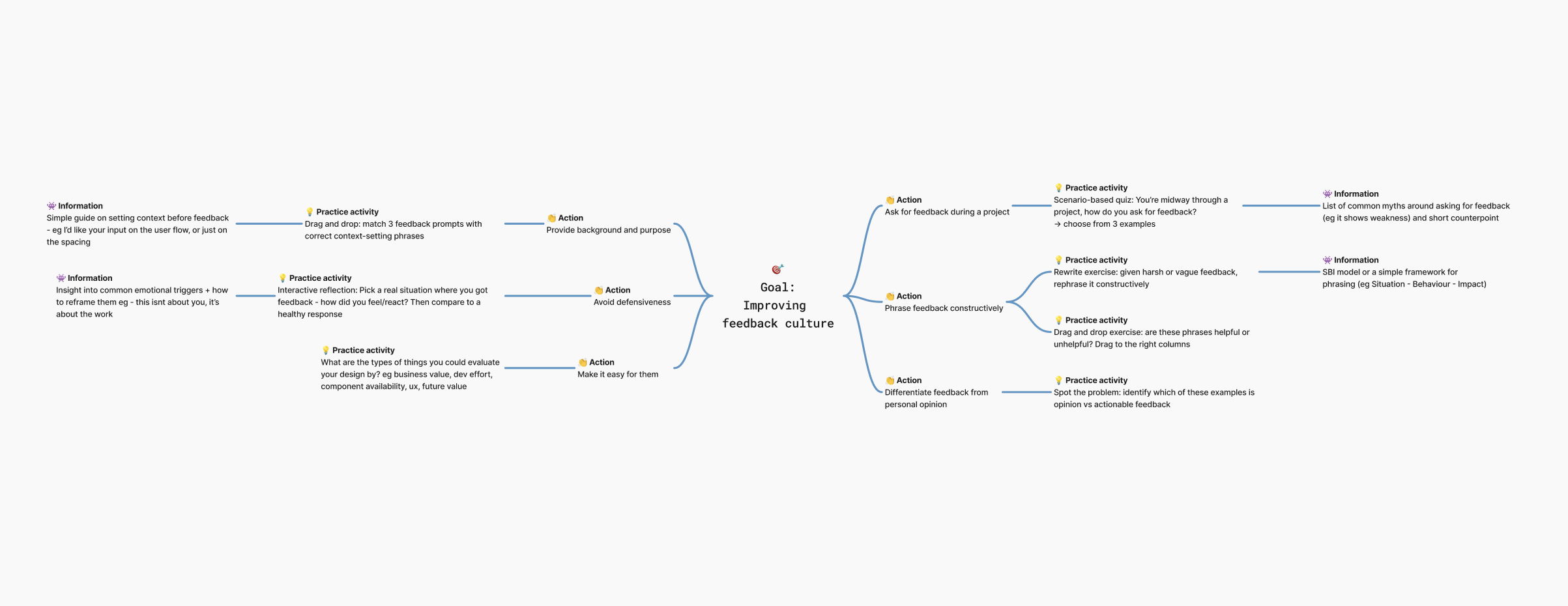
Action Map

Changes I made after mapping it

Once I mapped everything out, a few things changed:

  • I dropped an entire section on “types of feedback”. This felt too theoretical, not tied to the goal
  • I added a branching scenario idea to help learners practise tone and phrasing
  • I realised I needed to introduce frameworks like SBI/COIN after a scenario, not before, so learners could feel the pain of vague feedback first

Final thoughts

If you’re coming into Learning Design from UX, action mapping might feel pretty familiar. It’s essentially behaviour-led design, with an eye on what really matters. You’re not designing slides. You’re designing actions.

Action mapping gave me a way to connect the outcomes I’d written with the experience I wanted people to have. Less explaining. More doing.

Still figuring it out, but this was a solid turning point.

Highly recommend Cathy Moore’s work if you’re heading down this path:

Map It (her book)Cathy’s blog post on action mapping

Professional development

Learning design

Action mapping
Kat McGowan

September 5, 2025

Mapping behaviour, not screens: Applying UX to course design

I’m working away on my self-directed course about giving feedback, and still figuring things out as I go. So far I’ve got:

  • A working title: Feedback that fuels growth
  • A set of learning objectives:
    • Identify the key traits of constructive vs. unhelpful feedback
    • Use a simple framework (like SBI or COIN) to deliver clear, respectful feedback
    • Reflect on feedback without defensiveness
    • Ask for feedback that supports specific goals or outcomes

This all definitely gave me some direction, but when it came to how to actually teach those ideas? That was a different story.

At first, I figured I’d start with what people needed to know. That seemed logical. But it turns out knowledge isn’t the goal. Action is.

I needed a way to connect the end goal to what I was going to show, explain, or build activities around.

Enter: Action mapping

What is Action Mapping?

If you Google it, action mapping looks a bit like a mind map. But it’s much more structured and targeted.

Originally developed by Cathy Moore, action mapping is a visual approach to learning design that focuses on behaviour change. You start with a business or performance goal at its heart, then work backwards:

  • What do people need to do?
  • What’s getting in their way?
  • What practice or support could help?

No content for content’s sake. No five-slide explainers just because. Everything in service of the desired behaviour.

It felt a bit like a journey map for learning. Less about information, more about the steps and support needed along the way. I had to map not just what people should know, but everything they’d need to do to put feedback into practice. Where they might get stuck. What would help.

As a UX designer, this wasn’t unfamiliar. We often use journey maps or experience maps to do the same thing: start with the user’s goal, chart their steps, and figure out where interventions actually matter.

In both cases, mapping is about connecting outcomes to real behaviour changes, and clarifying where design effort will have the most impact. Whether you’re building a digital product or a course, that’s what it comes down to.

Why I used it

I didn’t want to build a passive “here’s what feedback is” module. The goal was to help people actually give better feedback, in real situations, not just in theory.

So I treated this like any other design challenge:

  • What actions do I want people to take?
  • Where are they getting stuck?
  • What do they need to practise?

Action mapping helped me step back from the urge to “cover everything,” and instead focus on doing less, better.

What it helped clarify

  • Which objectives needed active practice, and which were fine with a short example or explainer
  • Where I was making assumptions about what people already knew
  • Which content was just “nice to have” and didn’t need to be there at all

It also shifted how I was thinking about the module. I stopped planning slides, and started planning activities. What would learners do with the ideas, not just hear or read?

Action Map

Changes I made after mapping it

Once I mapped everything out, a few things changed:

  • I dropped an entire section on “types of feedback”. This felt too theoretical, not tied to the goal
  • I added a branching scenario idea to help learners practise tone and phrasing
  • I realised I needed to introduce frameworks like SBI/COIN after a scenario, not before, so learners could feel the pain of vague feedback first

Final thoughts

If you’re coming into Learning Design from UX, action mapping might feel pretty familiar. It’s essentially behaviour-led design, with an eye on what really matters. You’re not designing slides. You’re designing actions.

Action mapping gave me a way to connect the outcomes I’d written with the experience I wanted people to have. Less explaining. More doing.

Still figuring it out, but this was a solid turning point.

Highly recommend Cathy Moore’s work if you’re heading down this path:

Map It (her book)Cathy’s blog post on action mapping

Professional development

Learning by doing

Blooms taxonomy

Kat McGowan

September 5, 2025

Mapping behaviour, not screens: Applying UX to course design

I’m working away on my self-directed course about giving feedback, and still figuring things out as I go. So far I’ve got:

  • A working title: Feedback that fuels growth
  • A set of learning objectives:
    • Identify the key traits of constructive vs. unhelpful feedback
    • Use a simple framework (like SBI or COIN) to deliver clear, respectful feedback
    • Reflect on feedback without defensiveness
    • Ask for feedback that supports specific goals or outcomes

This all definitely gave me some direction, but when it came to how to actually teach those ideas? That was a different story.

At first, I figured I’d start with what people needed to know. That seemed logical. But it turns out knowledge isn’t the goal. Action is.

I needed a way to connect the end goal to what I was going to show, explain, or build activities around.

Enter: Action mapping

What is Action Mapping?

If you Google it, action mapping looks a bit like a mind map. But it’s much more structured and targeted.

Originally developed by Cathy Moore, action mapping is a visual approach to learning design that focuses on behaviour change. You start with a business or performance goal at its heart, then work backwards:

  • What do people need to do?
  • What’s getting in their way?
  • What practice or support could help?

No content for content’s sake. No five-slide explainers just because. Everything in service of the desired behaviour.

It felt a bit like a journey map for learning. Less about information, more about the steps and support needed along the way. I had to map not just what people should know, but everything they’d need to do to put feedback into practice. Where they might get stuck. What would help.

As a UX designer, this wasn’t unfamiliar. We often use journey maps or experience maps to do the same thing: start with the user’s goal, chart their steps, and figure out where interventions actually matter.

In both cases, mapping is about connecting outcomes to real behaviour changes, and clarifying where design effort will have the most impact. Whether you’re building a digital product or a course, that’s what it comes down to.

Why I used it

I didn’t want to build a passive “here’s what feedback is” module. The goal was to help people actually give better feedback, in real situations, not just in theory.

So I treated this like any other design challenge:

  • What actions do I want people to take?
  • Where are they getting stuck?
  • What do they need to practise?

Action mapping helped me step back from the urge to “cover everything,” and instead focus on doing less, better.

What it helped clarify

  • Which objectives needed active practice, and which were fine with a short example or explainer
  • Where I was making assumptions about what people already knew
  • Which content was just “nice to have” and didn’t need to be there at all

It also shifted how I was thinking about the module. I stopped planning slides, and started planning activities. What would learners do with the ideas, not just hear or read?

Action Map

Changes I made after mapping it

Once I mapped everything out, a few things changed:

  • I dropped an entire section on “types of feedback”. This felt too theoretical, not tied to the goal
  • I added a branching scenario idea to help learners practise tone and phrasing
  • I realised I needed to introduce frameworks like SBI/COIN after a scenario, not before, so learners could feel the pain of vague feedback first

Final thoughts

If you’re coming into Learning Design from UX, action mapping might feel pretty familiar. It’s essentially behaviour-led design, with an eye on what really matters. You’re not designing slides. You’re designing actions.

Action mapping gave me a way to connect the outcomes I’d written with the experience I wanted people to have. Less explaining. More doing.

Still figuring it out, but this was a solid turning point.

Highly recommend Cathy Moore’s work if you’re heading down this path:

Map It (her book)Cathy’s blog post on action mapping

Professional development

Learning design

Action mapping